Showing posts with label procrastination. Show all posts

Monday, May 7, 2012

Abstract clouds

Hey--

So I'm sure you've all seen word clouds ala wordle, where it takes all the text from a word document or webpage and then uses word frequencies to generate a kind of infographic where you can see the most used words, the big ideas if you will. 

Check it--someone made an app that you can input an author, it pulls all their pubmed abstracts, and then you can input that into wordle. It's called pubmed2wordle.

I decided to look up some of the PIs on my floor, in case I'm ever in the elevator with one of them, I can have some talking points. 

For example, 

Wordle: Untitled

I will know to talk about microRNAs with this dude, or

Wordle: Untitled

microRNAs but specifically let-7 with this woman, and also, oh look she works on C. elegans and development.

I think can be a great resource if there's a visiting faculty giving a seminar, or you're trying to pick a lab to rotate in, or you just want to know a little bit more about someone's research without spending hours poring over papers, this might be the first place I go from now on for all those things.

And just to mix it up a little big, because contrary to popular belief I'm not only interested in microRNAs...


Wordle: Untitled

That's my dad. He works on yeast and kinetochores and chromatin and microtubules!

It also makes for an interesting discussion of how much information do we actually need to understand something. And is relying on a tool like this, is that being lazy or being efficient? Obviously, it will never become a substitute for reading papers, but it's a pretty neat tool regardless. 

Do you think you could find yourself using something like this? Could you see yourself directing a student to it?  

Monday, November 14, 2011

Useful, Time-waster, or Useful time-waster?

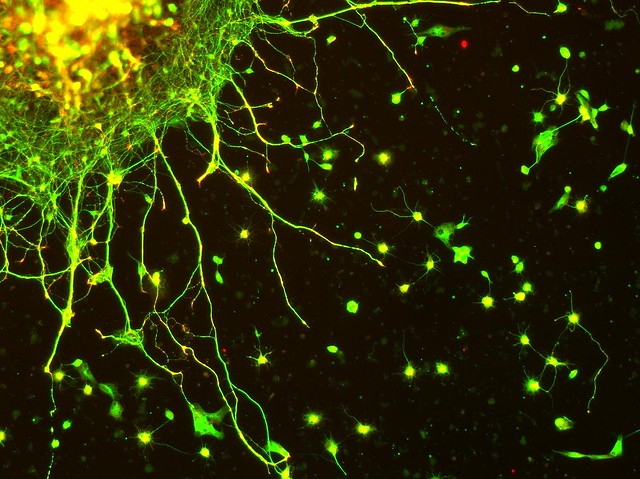
Edinger-Westphal neurons in culture. Stained for Tubulin (green) and Synapsin (red) Image via flickr
I've come to the conclusion that people in science are just really efficient procrastinators. And you know what really smart people do when they procrastinate? They come up with really cool ideas. Like this, meet Bionumbers. (B1ONUMB3R5?)

Its tagline is "The database of useful biological numbers", for when you just need a number and you end up poring through text books or endless articles when you need, the radius of an ATP molecule (~.7 nm) or the mean excitatory postsynaptic currents (EPSCs) amplitude of C. elegans. (38 +/-2.1 Hz), gosh I always forget that one, or just, overall human genome size (~3.08e9 bp). Oh, and an adult male brain has an average of 8.61e10 +/-8.12e9 neurons. Which makes perfect sense.

You search for something, it pops up in a handy table, and it even comes with a citation, so you know, you don't have to cite Bionumbers in whatever homework assignment/paper you're doing.

It looks like fun. I just spent a lot of time under Amazing BioNumbers and found out that the characteristic heart rate of a pond mussel was 4-6 beats per minute.

I would classify that piece of knowledge as could-be-conceivably-useful-in-conversation-time-waster.

Those systems biologists, what will they come up with next.